Abstract
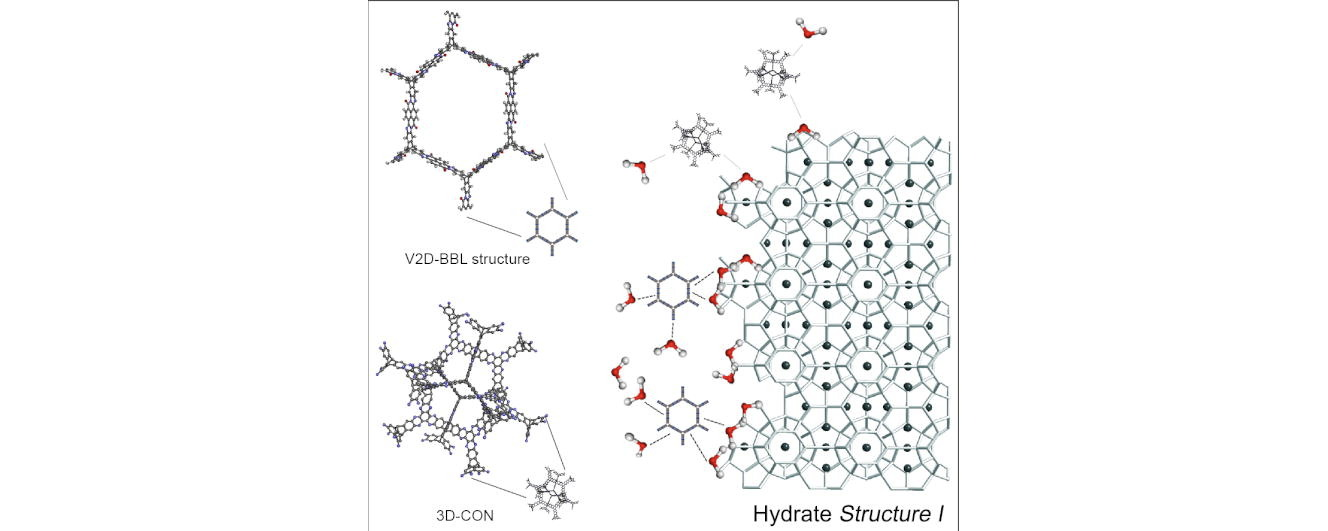
Fused aromatic networks (FANs) are attracting considerable interest in the scientific community because of their intriguing electronic properties and superior physiochemical stability due to their fully fused aromatic systems. Here, a three-dimensional (3D) cage-like organic network (3D-CON) and a vertical two-dimensional (2D) layered ladder structure (designated as V2D-BBL structure) were studied as materials for gas hydrate inhibitors because of their outstanding stability in high-pressure/low-temperature and periodically incorporated molecular building blocks. The V2D-BBL structure demonstrated remarkable performance, inhibiting the formation of both methane (CH4) and carbon dioxide (CO2) hydrates, comparable to conventional lactam-based polymers. It was determined that the designed perinone moiety in the V2D-BBL structure enables synergistic interactions with the host (water) and guest (CH4) molecules involved in hydrate nucleation. Given their pre-designability and inherent stability, the FANs hold enormous potential as gas hydrate inhibitors for industrial applications.
완전 융합된 방향족 골격으로 인해 매력적인 전자적 특성과 우수한 물리화학적 안정성을 지닌 융합 방향족 네트워크(FANs)는 학계에서 큰 관심을 받고 있습니다. 본 연구에서는 고압/저온 환경에서의 뛰어난 안정성과 주기적으로 도입된 분자 빌딩 블록을 고려하여, 3차원 케이지형 유기 네트워크(3D-CON)와 수직 2차원 적층 래더 구조(V2D-BBL 구조)를 가스 하이드레이트 억제제 후보로 조사하였습니다. V2D-BBL 구조는 메탄(CH₄)과 이산화탄소(CO₂) 하이드레이트의 형성을 모두 억제하는 뛰어난 성능을 보여주었으며, 이는 기존의 락탐 기반 고분자와 비견할 만한 수준이었습니다. 또한 V2D-BBL 구조에 설계된 페리논(perinone) 작용기가 하이드레이트 핵생에 관여하는 숙주(물) 및 게스트(CH₄) 분자와 시너지 상호작용을 가능하게 함이 확인되었습니다. FANs는 사전 설계 가능성과 고유한 안정성을 겸비하고 있으므로, 산업 적용을 위한 가스 하이드레이트 억제제로서 큰 잠재력을 지닙니다.