Abstract
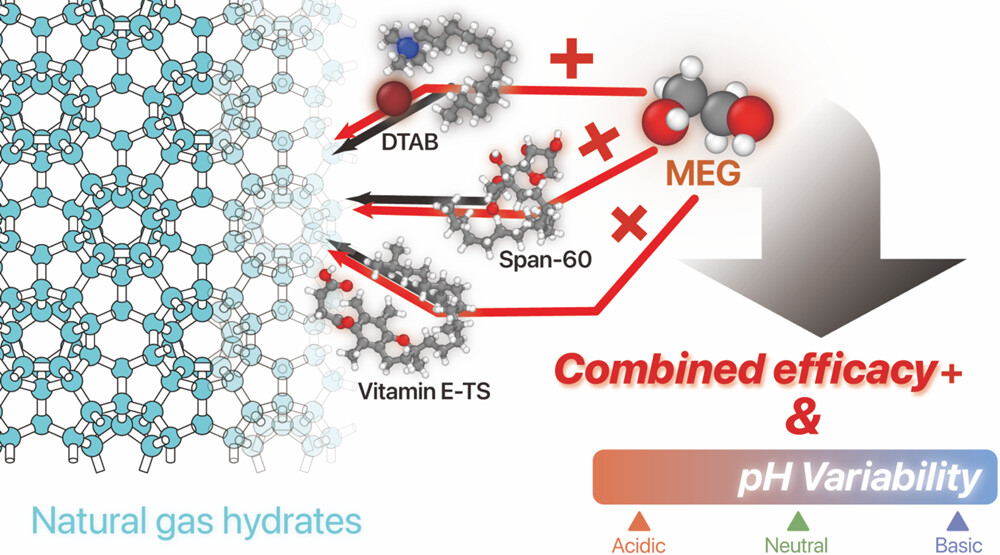
This research addresses the challenges of gas hydrate formation in subsea flowlines, focusing on the investigation of antiagglomerants (AAs): Vitamin E derivative (d-alpha tocopherol succinate, Vitamin E-TS), sorbitan monostearate (Span-60), and dodecyl trimethylammonium bromide (DTAB), and their synergistic interactions with monoethylene glycol (MEG). Through an in-depth examination of hydrate onset time, growth rate, and torque change under varying pH values, this study offers comprehensive insights into the performance of the selected AAs and their combined efficacy with MEG in hydrate inhibition. The experimental results reveal notable variations in hydrate formation and inhibition characteristics, highlighting the influence of different AAs and their interactions with MEG. The study demonstrates the potential of Vitamin E-TS in altering hydrate formation kinetics, Span-60 in maintaining hydrate particle dispersion, and DTAB in mitigating hydrate agglomeration. These findings contribute to a nuanced understanding of hydrate dynamics and provide valuable insights for the development of more effective and cost-efficient hydrate management strategies in the industry. The research enriches the ongoing dialogue on hydrate inhibition and presents a thorough exploration of methodologies, results, and their implications in this critical field of study.
본 연구는 해저 플로우라인에서의 가스 하이드레이트 형성 문제를 다루며, 응집방지제(AAs)인 비타민 E 유도체(d-α-토코페롤 숙시네이트, Vitamin E-TS), 소르비탄 모노스테아레이트(Span-60), 도데실 트라이메틸암모늄 브로마이드(DTAB)와 모노에틸렌글리콜(MEG) 간의 시너지 상호작용을 조사하였습니다. pH 조건을 달리하여 하이드레이트 생성 개시 시간, 성장 속도, 토크 변화를 심층적으로 검토함으로써, 선택된 AAs의 성능과 MEG와의 결합 효과를 포괄적으로 평가하였습니다. 실험 결과는 하이드레이트 형성 및 억제 특성에서 뚜렷한 차이를 보여주었으며, AA의 종류와 MEG와의 상호작용이 이러한 차이에 큰 영향을 미침을 확인하였습니다.
특히 Vitamin E-TS는 하이드레이트 형성 동적을 변화시키는 잠재력을 보였고, Span-60은 하이드레이트 입자의 분산 유지를 돕는 것으로 나타났으며, DTAB는 하이드레이트 응집을 완화하는 데 기여하였습니다. 이러한 결과는 하이드레이트 동학과 거동에 대한 정교한 이해를 제공하며, 산업 현장에서 보다 효과적이고 비용 효율적인 하이드레이트 관리 전략 개발에 유의미한 시사점을 제공합니다. 본 연구는 하이드레이트 억제에 관한 지속적인 논의에 기여하고, 관련 방법론·결과 및 그 함의에 대한 면밀한 고찰을 제시합니다.