Abstract
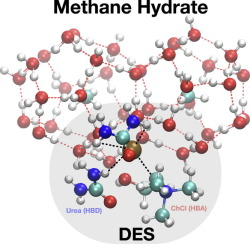
In this study, the thermodynamic inhibition effects of choline chloride (ChCl, a hydrogen bond acceptor), urea (a hydrogen bond donor), and their mixture (deep eutectic solvent, DES) on CH4 hydrates were investigated with both experimental and computational approaches. The synthesis of DES from the mixture of ChCl and urea was confirmed by measuring its melting temperature through a high-pressure micro-differential scanning calorimeter. Sigma (σ)-profiles of ChCl, urea, and DES obtained by the COSMO-RS software indicated that these substances have great potential to be used as thermodynamic hydrate inhibitors (THIs). The three-phase (gas hydrate (H) – liquid water (Lw) – vapor (V)) equilibria of CH4 hydrates in the presence of ChCl (1.0, 3.0, and 5.0 mol%), urea (1.0, 3.0, and 5.0 mol%), and DES (3.0 mol%) demonstrated that ChCl, urea, and DES contributed to the significant shift of hydrate equilibrium temperature to inhibition regions at a specified pressure and thus can function as effective THIs. Moreover, quantum theory of atoms in molecules (QTAIM) analysis also demonstrated that the strength of hydrogen bonding between inhibitor molecules and hydrate cages (small 512 and large 51262 cages) of CH4 hydrates was in the order of ChCl > DES > urea, which was consistent with experimental results. The experimental and computational results from this study would be helpful for a better understanding of the inhibition mechanism of ChCl, urea, and DES and for their possible application to flow assurance in oil and gas pipelines.
Redirectingdoi.org본 연구에서는 콜린 염화물(ChCl, 수소결합 수용체), 요소(수소결합 공여체), 그리고 두 물질의 혼합물인 심융성 용매(DES, deep eutectic solvent)가 메탄(CH₄) 하이드레이트에 미치는 열역학적 억제 효과를 실험적·계산적 방법으로 조사하였습니다. 고압 마이크로 시차주사열량계(µDSC)를 이용한 융점 측정을 통해 ChCl–요소 혼합물로부터 DES의 합성을 확인하였습니다. COSMO-RS 소프트웨어로 얻은 ChCl, 요소, DES의 σ-프로파일은 이들 물질이 열역학적 하이드레이트 억제제(THI)로서의 높은 잠재력을 지님을 시사하였습니다.
또한 CH₄ 하이드레이트에 대해 ChCl(1.0, 3.0, 5.0 mol%), 요소(1.0, 3.0, 5.0 mol%), DES(3.0 mol%)가 존재하는 조건에서 삼상(가스 하이드레이트(H)–액상 물(Lw)–기상(V)) 평형을 측정한 결과, 동일 압력에서 하이드레이트 평형 온도가 억제 영역으로 유의하게 이동함을 확인하였으며, 이에 따라 이들이 효과적인 THI로 기능할 수 있음을 입증하였습니다. 아울러, 분자 내 원자에 대한 양자이론(QTAIM) 분석을 통해 CH₄ 하이드레이트의 케이지(소형 5¹², 대형 5¹²6²)와 억제제 분자 간 수소결합 강도가 ChCl > DES > 요소 순서임을 보였고, 이는 실험 결과와 일치하였습니다.
이상의 실험 및 계산 결과는 ChCl, 요소, DES의 억제 메커니즘에 대한 이해를 심화시키며, 석유·가스 파이프라인의 유동 보장(flow assurance)에의 적용 가능성 평가에 유용한 근거를 제공합니다.