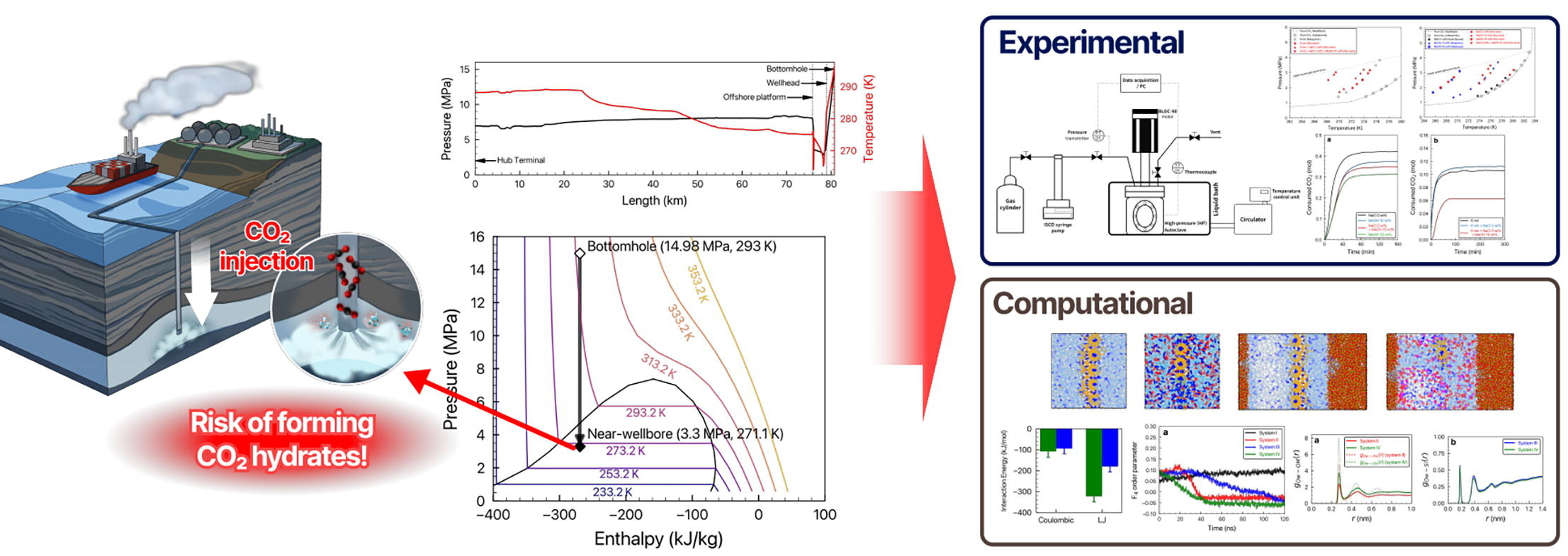
Sequestering CO2 in depleted gas reservoirs using carbon capture, utilization, and storage technologies has emerged as a viable strategy for mitigating global carbon emissions. However, CO2 hydrate formation during injection processes is challenging and poses a risk to the operational integrity and efficiency of sequestration projects. This study investigated CO2 hydrate formation dynamics within silica gel environments that closely mimicked the median pore size of natural sandstone reservoirs, particularly targeting depleted gas fields in the East Sea of Korea. Integrating kinetic insights into experimental hydrate formation assessments and molecular dynamics simulations provided a comprehensive understanding of the CO2 hydrate formation mechanisms, as well as the formation dynamics and stability of the CO2 hydrates. For example, the hydrate formation kinetics were significantly reduced in the small pores, suggesting the feasibility of implementing more economical hydrate inhibitor injection strategies during CO2 injection. Moreover, this study evaluated the inhibitory effects of NaCl and methanol on CO2 hydrate stability by accurately measuring the three-phase (H-Lw-V) equilibria and employing silica gels (6 nm pore size). The presence of methanol and amorphous silica significantly impacted hydrate formation, with methanol potentially influencing the local structure around the hydrate phase and silica hindering hydrate growth through dynamic interactions with CO2 molecules. In addition, we elucidated the complex interplay between CO2, water, and methanol (hydrate inhibitor) within the constrained environments of porous media, offering strategic insights for the development of effective CO2 injection and sequestration strategies. Integrating molecular-level observations with real-world geological modeling presents a novel methodology for enhancing the safety, efficiency, and environmental sustainability of carbon capture and storage operations. The findings of this study provide critical insights into hydrate phase behavior, highlighting the importance of precise equilibrium determination under simulated reservoir conditions to effectively anticipate and mitigate hydrate formation challenges.
탄소 포집·활용·저장(CCUS) 기술을 활용하여 고갈 가스 저류층에 CO₂를 격리(저장)하는 것은 전 지구적 탄소 배출을 완화하기 위한 실행 가능한 전략으로 부상하였습니다. 그러나 주입 과정에서의 CO₂ 하이드레이트 형성은 도전과제를 제기하며, 격리 사업의 운전 무결성과 효율성에 위험을 초래합니다. 본 연구는 특히 대한민국 동해의 고갈 가스전을 대상으로, 천연 사암 저류층의 대표 기공 크기를 근사한 실리카 겔 환경에서 CO₂ 하이드레이트 형성의 동적 특성을 조사하였습니다.
실험적 하이드레이트 형성 평가에 동적 관점을 통합하고 분자동역학(MD) 시뮬레이션을 병행함으로써, CO₂ 하이드레이트의 형성 메커니즘과 형성 동적 및 안정성에 대한 포괄적 이해를 도출하였습니다. 예를 들어, 작은 기공에서는 하이드레이트 형성 속도가 유의하게 감소하여, CO₂ 주입 시 보다 경제적인 하이드레이트 억제제 주입 전략의 실현 가능성을 시사하였습니다.
아울러, 실리카 겔(기공 크기 6 nm)을 사용하고 3상(H–Lw–V) 평형을 정밀 측정함으로써 NaCl과 메탄올의 CO₂ 하이드레이트 안정성에 대한 억제 효과를 평가하였습니다. 메탄올과 무정형 실리카의 존재는 하이드레이트 형성에 유의한 영향을 미쳤으며, 메탄올은 하이드레이트 상 주변의 국소 구조에 영향을 줄 수 있고, 실리카는 CO₂ 분자와의 동적 상호작용을 통해 하이드레이트 성장을 저해하는 것으로 나타났습니다.
또한, 다공성 매질의 제약된 환경에서 CO₂–물–메탄올(하이드레이트 억제제) 간의 복합 상호작용을 규명하여, 효과적인 CO₂ 주입 및 격리 전략 수립을 위한 전략적 시사점을 제공하였습니다. 분자 수준의 관찰과 실환경 지질학적 모델링을 통합하는 접근은 CCUS 운영의 안전성, 효율성, 환경적 지속가능성을 향상시키기 위한 새로운 방법론을 제시합니다. 본 연구의 결과는 하이드레이트 상거동에 대한 핵심 통찰을 제공하며, 모사 저류층 조건하에서 정밀 평형 결정의 중요성을 강조하여 하이드레이트 형성 문제를 효과적으로 예측·완화하는 데 기여합니다.