Abstract
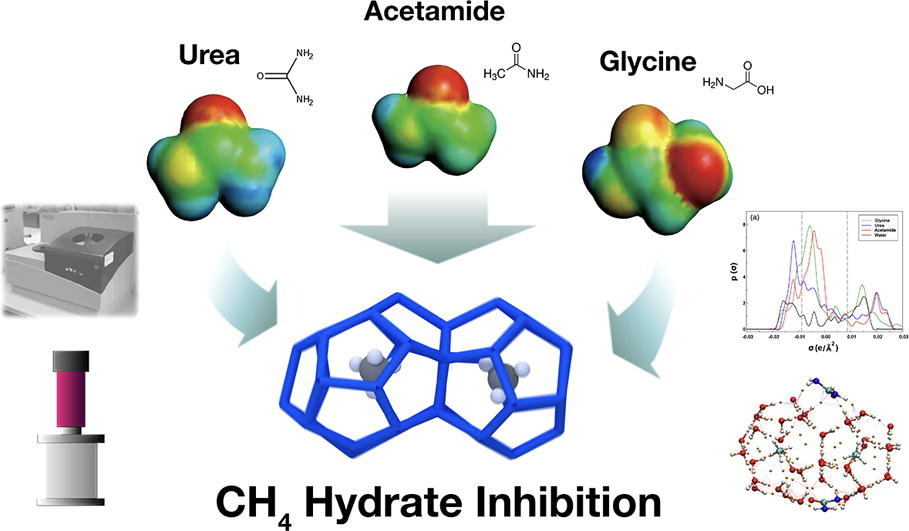
In this study, urea (U), acetamide (A), and glycine (G), which are easily decomposable, were suggested as kinetic hydrate inhibitors (KHIs) and potential synergists for CH4 hydrate. The inhibition performance of these substances was evaluated by measuring the onset temperature of CH4 hydrate via both a stirred high-pressure autoclave and a non-stirred high-pressure micro-differential scanning calorimeter. In addition, two quantum mechanics approaches of COnductor-like Screening MOdel for Real Solvents (COSMO-RS) and quantum theory of atoms in molecules (QTAIM), were used to examine the hydrophilicity of the inhibitor candidates and to elucidate the synergism of the inhibitor mixtures. The σ-profile and σ-potential analyses using COSMO-RS indicated that the three monomeric substances have a significant potential as gas hydrate inhibitors by forming hydrogen bonds with host water molecules. The experimental results demonstrated that glycine was the best KHI among the three candidates, and either of two combinations (U + A, U + G, and A + G) had synergistic inhibition effects on CH4 hydrate. The A + G mixture showed the lowest onset temperature, i.e., the best synergism. QTAIM analysis showed that when two different inhibitor molecules were bound to the bi-cage hydrate structure, the absolute value of hydrogen bond energy between inhibitors and water molecules was larger compared to the attachment of two identical inhibitor molecules. The overall combined experimental and computational analyses not only suggest the possibility of hydrophilic monomeric substances as potent KHIs but also offer a new way to reveal the mechanism of hydrate inhibition.
Redirectingdoi.org본 연구에서는 분해가 용이한 요소(urea, U), 아세트아마이드(acetamide, A), 글라이신(glycine, G)을 메탄(CH₄) 하이드레이트용 동적 하이드레이트 억제제(KHI) 및 잠재적 시너지제로 제안하였습니다. 교반식 고압 오토클레이브와 비교반식 고압 마이크로 시차주사열량계(µDSC)를 이용하여 CH₄ 하이드레이트의 생성 개시 온도를 측정함으로써 이들 물질의 억제 성능을 평가하였습니다. 아울러, 두 가지 양자화학 접근법인 COSMO-RS(실제 용매를 위한 도체-유사 스크리닝 모델)와 QTAIM(분자 내 원자에 대한 양자이론)을 사용하여 후보 억제제의 친수성을 평가하고 억제제 혼합물의 시너지 메커니즘을 규명하였습니다.
COSMO-RS 기반의 σ-프로파일 및 σ-포텐셜 분석 결과, 세 단량체 물질은 숙주인 물 분자와 수소결합을 형성함으로써 가스 하이드레이트 억제제로서 유의미한 잠재력을 갖는 것으로 나타났습니다. 실험적으로는 세 후보 중 G가 가장 우수한 KHI 성능을 보였으며, U+A, U+G, A+G의 두 성분 조합은 모두 CH₄ 하이드레이트에 대해 시너지 억제 효과를 나타냈습니다. 그중 A+G 혼합물이 가장 낮은 생성 개시 온도(즉, 가장 큰 시너지)를 보였습니다.
QTAIM 분석에 따르면 서로 다른 두 억제제 분자가 이중 케이지(bi-cage) 하이드레이트 구조에 결합할 때, 동일한 억제제 두 분자가 결합하는 경우에 비해 억제제-물 분자 간 수소결합 에너지의 절대값이 더 크게 나타났습니다.
종합하면, 실험 및 계산 분석 결과는 친수성 단량체 물질이 유력한 KHI가 될 수 있음을 시사할 뿐 아니라, 하이드레이트 억제 메커니즘을 규명하는 새로운 접근을 제시합니다.