Abstract
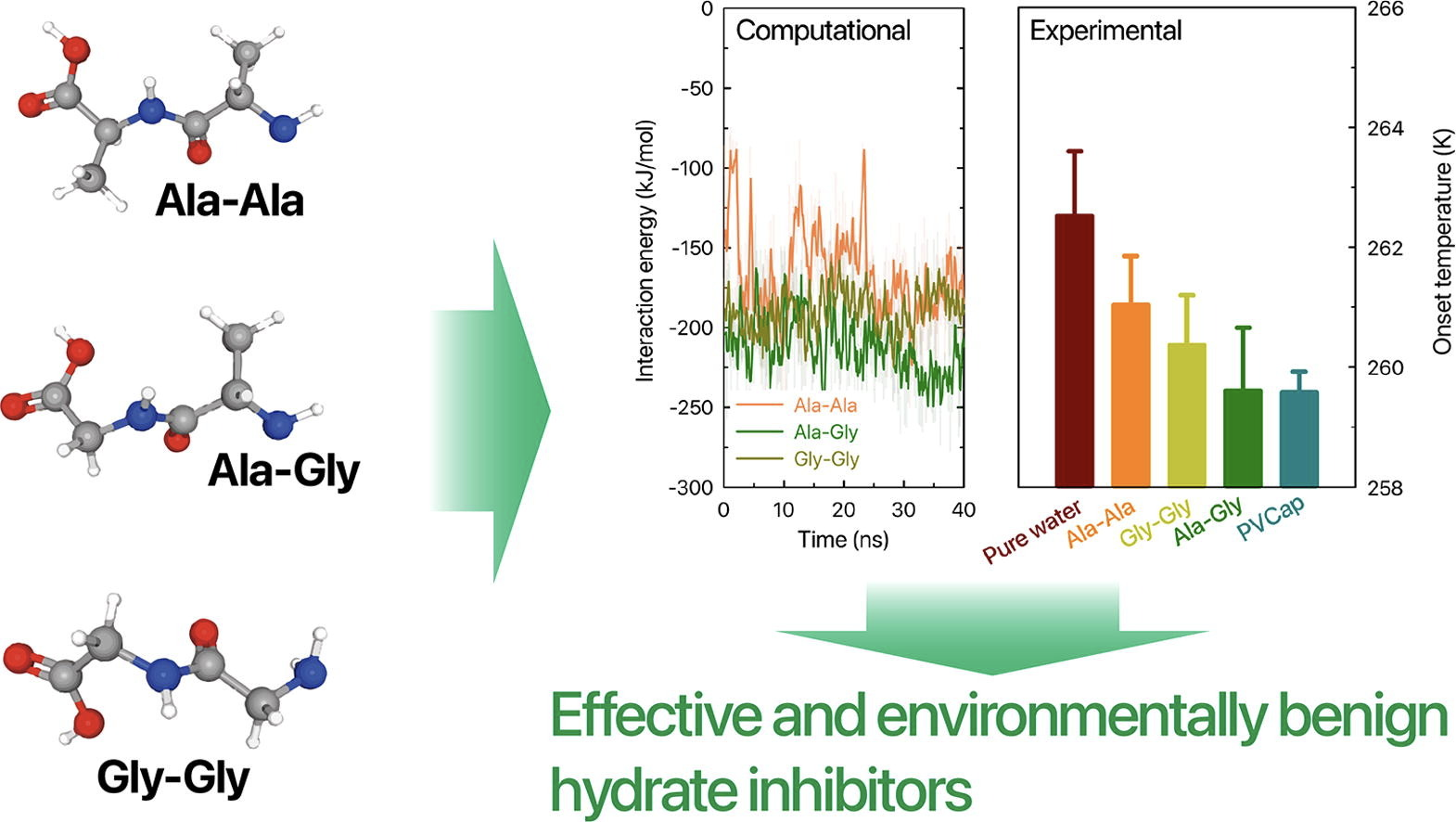
In this study, three dipeptides (Gly-Gly, Ala-Ala, and Ala-Gly) were appraised as environmentally benign hydrate inhibitors for CH4 hydrate using both experimental and computational methods. Their kinetic inhibition performance was experimentally evaluated using a stirred high-pressure autoclave and a non-stirred high-pressure micro-differential scanning calorimeter. The experimental results demonstrated that the three dipeptides functioned well as CH4 hydrate inhibitors. Ala-Gly was found to be the most effective, and its inhibition performance was comparable to that of polyvinylcaprolactam (PVCap), a polymer-based commercial hydrate inhibitor. Snapshots, hydrate counts, F3 and F4 order parameters, displacement magnitude, mean square displacement, and radial distribution functions of each peptide-containing system were examined using molecular dynamics (MD) simulations to reveal the inhibition mechanism of dipeptides. The MD simulations showed that the N-termini of the dipeptides were the key constituents for inhibiting the CH4 hydrate, and the Ala-Gly-containing system had the strongest interaction between dipeptide molecules and CH4 hydrate. The overall results provide a better understanding of nature-derived, environmentally friendly hydrate inhibitors and offer insights into the molecular inhibition mechanism of various potential inhibitors.
Redirectingdoi.org본 연구는 실험 및 계산적 접근을 통해 디펩타이드(Gly-Gly, Ala-Ala, Ala-Gly)를 메탄(CH₄) 하이드레이트용 환경친화적 하이드레이트 억제제로 평가하였습니다. 교반식 고압 오토클레이브와 비교반식 고압 마이크로 시차주사열량계(µDSC)를 사용하여 동적 억제 성능을 실험적으로 평가하였고, 그 결과 세 디펩타이드 모두 CH₄ 하이드레이트 억제제로서 유효하게 기능함을 확인하였습니다. 특히 Ala-Gly가 가장 우수한 성능을 보였으며, 상용 고분자계 억제제인 폴리비닐카프로락탐(polyvinylcaprolactam, PVCap)과 견줄 만한 억제 성능을 나타냈습니다.
분자동역학(MD) 시뮬레이션에서는 각 펩타이드가 포함된 계에 대해 스냅샷, 하이드레이트 개수, F3 및 F4 질서 매개변수, 변위 크기, 평균 제곱 변위(MSD), 방사형 분포 함수(RDF)를 분석하여 디펩타이드의 억제 메커니즘을 규명하였습니다. MD 결과에 따르면 디펩타이드의 N-말단이 CH₄ 하이드레이트 억제의 핵심 구성요소로 작용하였으며, Ala-Gly 함유 계에서 디펩타이드 분자와 CH₄ 하이드레이트 사이의 상호작용이 가장 강했습니다. 본 연구의 종합적 결과는 자연 유래의 환경친화적 하이드레이트 억제제에 대한 이해를 심화시키고, 다양한 잠재적 억제제의 분자적 억제 메커니즘에 관한 유의미한 시사점을 제공합니다.