Abstract
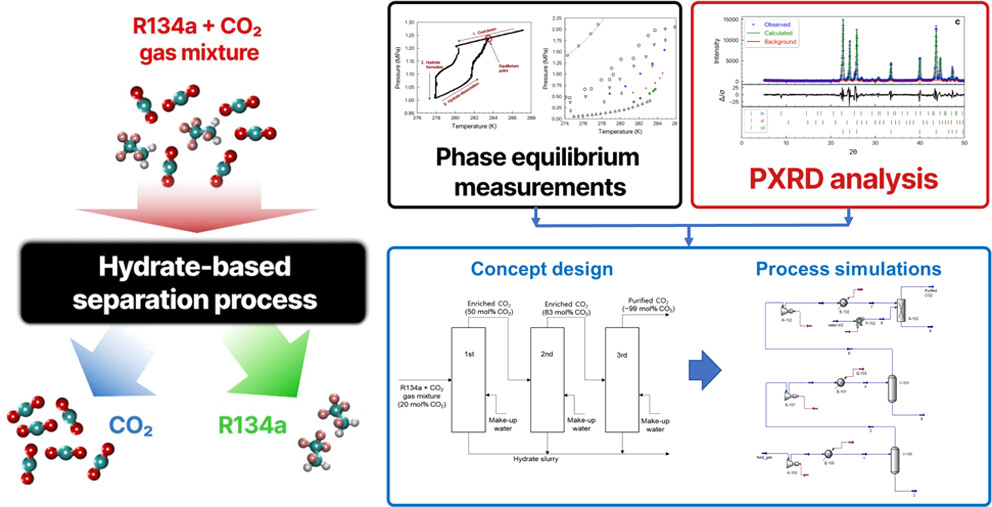
The quest for environmentally sustainable solutions for CO2 recovery and purification has led to the development of innovative separation techniques, which are crucial for carbon capture, utilization, and storage (CCUS) applications. Moreover, refrigerant recovery techniques have been widely developed after the implementation of stringent global regulations on hydrofluorocarbon (HFC) emissions. This study explores the separation of R134a, a well-known HFC, from carbon dioxide (CO2), focusing on the feasibility of hydrate-based processes for the recovery of high-purity CO2. Phase equilibrium measurements, spectroscopic analysis, and process simulation studies were systematically performed to evaluate the operation conditions and energy requirements of the hydrate-based separation processes. Phase equilibrium measurements for R134a + CO2 mixtures at various concentrations were performed along with the structural analysis of mixed hydrates using low-temperature powder X-ray diffraction (PXRD). The experiments demonstrated the preferential occupation of R134a into hydrate cages, enriching CO2 in the vapor phase and achieving target purity levels of 99.0 mol % CO2. The PXRD patterns confirmed the formation of structure II hydrates with a lattice parameter of 17.2 Å with inclusions of R134a in large cages, resulting in a higher exothermic heat of formation compared with that of structure I hydrates. Process simulations were performed to further extend these findings, highlighting the favorable operation conditions and the exothermic nature of hydrate formation, which suggested heat integration into other process units. This study represents a pioneering effort in modeling hydrate-based CO2 recovery processes, providing a significant contribution to the development of sustainable industrial practices and the advancement of CCUS technologies.
환경적으로 지속가능한 CO₂ 회수 및 정제를 위한 해결책 모색은 탄소 포집·활용·저장(CCUS) 응용에서 핵심적인 분리 기술의 발전으로 이어져 왔습니다. 또한 하이드로플루오로카본(HFC) 배출에 대한 엄격한 국제 규제 시행 이후, 냉매 회수 기술 역시 광범위하게 개발되고 있습니다. 본 연구는 대표적 HFC인 R134a(HFC-134a, 1,1,1,2-테트라플루오로에테인)로부터 이산화탄소(CO₂)를 분리하는 문제를 다루며, 고순도 CO₂ 회수를 위한 가스 하이드레이트 기반 공정의 실현 가능성을 평가하였습니다. 이를 위해 상평형 측정, 분광학적 분석, 공정 시뮬레이션을 체계적으로 수행하여 운전 조건과 에너지 요구량을 검토하였습니다.
해당 연구에서는 다양한 조성의 R134a+CO₂ 혼합물에 대해 상평형을 측정하고, 저온 분말 X선 회절(PXRD)을 통한 혼합 하이드레이트의 구조 분석을 병행하였습니다. 실험 결과 R134a가 하이드레이트 케이지를 선호적으로 점유하여 CO₂가 기상에서 농축되었으며, CO₂ 99.0 mol%의 목표 순도를 달성하였습니다. PXRD 패턴은 대형 케이지에 R134a가 포함된 구조 II(sII) 하이드레이트의 형성(격자 상수 a ≈ 17.2 Å)을 확인하였고, 이로 인해 구조 I(sI) 하이드레이트에 비해 형성 과정의 발열이 더 크게 나타났습니다. 공정 시뮬레이션 결과는 유리한 운전 조건과 하이드레이트 형성의 발열적 특성을 부각하며, 생성 열을 다른 공정 단위와 통합하는 열통합 가능성을 시사하였습니다. 본 연구는 하이드레이트 기반 CO₂ 회수 공정의 모델링을 선도적으로 제시함으로써, 지속가능한 산업 관행 확립과 CCUS 기술 발전에 기여할 수 있을 것으로 사료됩니다.