Abstract
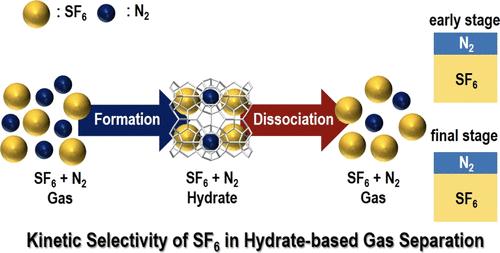
The time-dependent selectivity of SF6, the most potent global warming gas, in the hydrate-based gas separation process was investigated through both experimental and computational approaches. Guest-enclathrating and guest-releasing behaviors in SF6 + N2 hydrate were observed via gas chromatography, in situ Raman spectroscopy, and molecular dynamics (MD) simulations. The increasing pattern of the normalized area ratio of the Raman peak for enclathrated SF6 molecules was similar to that for enclathrated N2 during hydrate formation, and the composition of SF6 in the hydrate phase was almost constant throughout hydrate formation. MD simulations also showed that the captured SF6/N2 ratio in the hydrate structure was nearly constant over time. These results evidenced no remarkable difference in kinetic selectivity between SF6 and N2 during hydrate formation. The in situ Raman spectra and MD simulations examined during hydrate dissociation also demonstrated that SF6 was not kinetically selective in the guest-releasing process. The overall experimental and computational results indicated that none of the guest molecules in the SF6 + N2 hydrate were kinetically selective during formation and dissociation despite the superior thermodynamic selectivity of SF6. The findings of this work provide the features of guest-filling and guest-liberating behaviors during the formation and dissociation of SF6 + N2 hydrate. They will contribute to the determination of the optimal operation time for hydrate formation and thus to the development of the hydrate-based SF6 separation process.
본 연구는 하이드레이트 기반 가스 분리 공정에서 지구온난화 영향이 매우 큰 육불화황(SF₆)의 시간 의존적 선택성을 실험적·계산적 접근으로 조사하였습니다. SF₆+N₂ 하이드레이트에서의 게스트 포접 및 방출 거동을 기체 크로마토그래피(GC), in situ 라만 분광법, 분자동역학(MD) 시뮬레이션을 통해 관찰하였습니다. 하이드레이트 형성 동안 포접된 SF₆에 대응하는 라만 피크의 정규화 면적비 증가 양상은 포접된 N₂의 그것과 유사하였으며, 하이드레이트 상의 SF₆ 조성은 형성 전 과정에서 거의 일정하게 유지되었습니다. MD 시뮬레이션 또한 하이드레이트 구조 내에 포집된 SF₆/N₂ 비율이 시간에 따라 거의 일정함을 보여주었습니다. 이러한 결과는 하이드레이트 형성 중 SF₆와 N₂ 사이에 동적 선택성의 현저한 차이가 없음을 입증하였습니다.
분해 과정에서 수행한 in situ 라만 분광 및 MD 시뮬레이션 역시 게스트 방출 단계에서 SF₆가 동적 선택성을 보이지 않음을 확인하였습니다. 종합하면, SF₆의 우수한 열역학적 선택성에도 불구하고 SF₆+N₂ 하이드레이트에서는 형성과 분해 과정 전반에 걸쳐 어떤 게스트 분자도 동적으로 선택적이지 않았습니다. 본 연구의 결과는 SF₆+N₂ 하이드레이트의 형성·분해에서 나타나는 게스트 포접·방출 거동의 특성을 제시하며, 하이드레이트 형성의 최적 운전 시간 결정과 하이드레이트 기반 SF₆ 분리 공정의 개발에 기여합니다.