Abstract
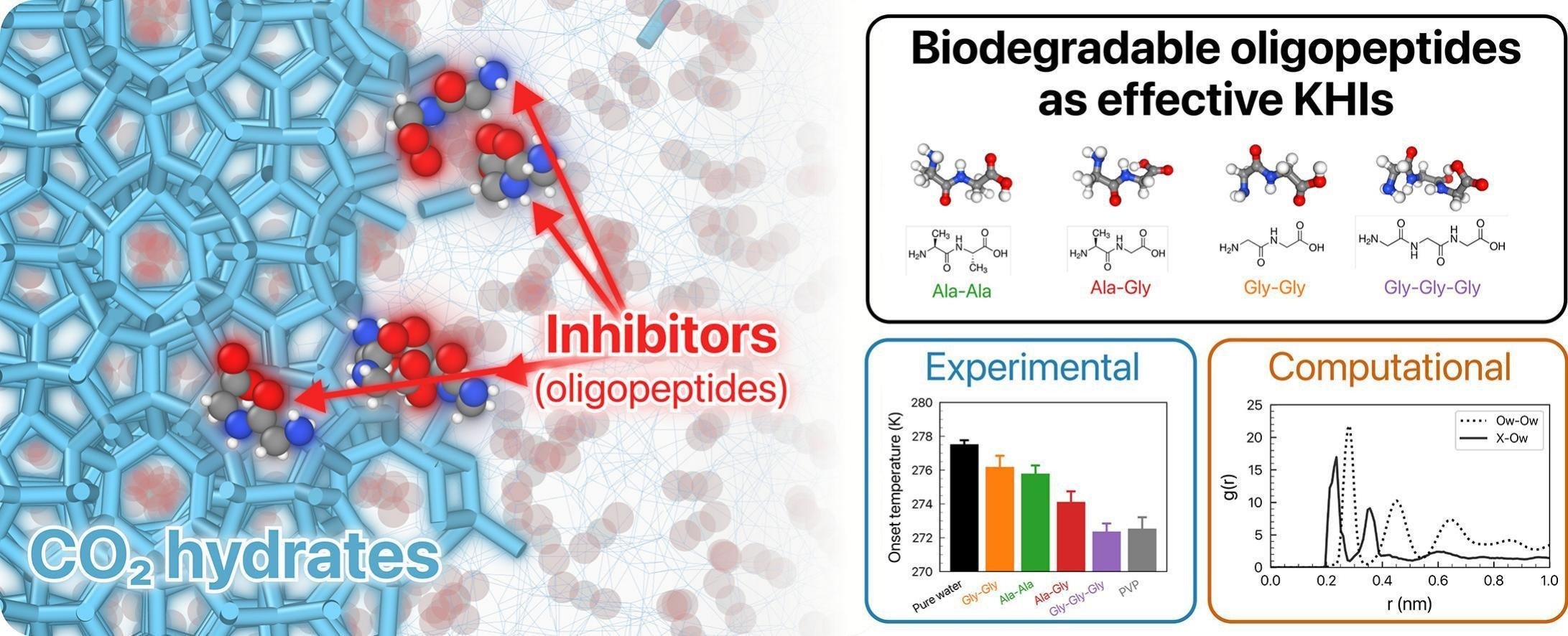
The current emphasis on achieving carbon neutrality underscores the significance of carbon capture, utilization, and storage, making the avoidance of CO2 hydrate formation in transmission and transport pipelines crucial. Considering this, the present study explored the potential of oligopeptides as biodegradable kinetic hydrate inhibitors (KHIs) for inhibiting CO2 hydrate formation. Dipeptides (L-alanyl-L-alanine [Ala-Ala], L-alanylglycine [Ala-Gly], and glycylglycine [Gly-Gly]) and a tripeptide (glycylglycylglycine [Gly-Gly-Gly]) were investigated through a combination of experimental measurements and molecular dynamics (MD) simulations. Onset temperature measurements were obtained to evaluate the inhibition effects of the oligopeptides. The results demonstrated the effective hindrance of CO2 hydrate formation by the oligopeptides at a significantly low concentration (1.0 wt%). The MD simulations provided molecular-level insights into the hydrate inhibition mechanisms of the oligopeptides during CO2 hydrate formation, revealing their influence on the growth, dissociation, and structural dynamics of CO2 hydrates. Additional investigations involving mean square displacement, diffusion coefficients, and radial distribution function provided a deeper understanding of molecular motion, mobility, and hydrate bond disruption in the presence of the oligopeptides. The research findings highlight the efficacy of oligopeptides as novel KHIs for inhibiting CO2 hydrate formation, thereby contributing to the development of environmentally friendly KHIs and the sustainable management of CO2 transmission and transport pipelines.
탄소중립 달성을 위해서는 탄소 포집·활용·저장(CCUS)이 필수적이며, 이를 위해선 이송·수송 배관에서의 CO₂ 하이드레이트 형성 방지가 중요합니다. 이러한 맥락에서, 해당 연구는 생분해성 동적 하이드레이트 억제제(KHI)로서 올리고펩타이드의 CO₂ 하이드레이트 형성 억제 가능성을 모색하였습니다. 디펩타이드(L-알라닐-L-알라닌 [Ala-Ala], L-알라닐글리신 [Ala-Gly], 글리실글리신 [Gly-Gly])와 트리펩타이드(글리실글리실글리신 [Gly-Gly-Gly])를 대상으로 실험 측정과 분자동역학(MD) 시뮬레이션을 병행하여 조사하였습니다. 하이드레이트 생성 개시 온도를 측정하여 올리고펩타이드의 억제 효과를 평가하였으며, 그 결과 질량 기준 1.0 wt%의 유의미하게 낮은 농도에서도 올리고펩타이드가 CO₂ 하이드레이트 형성을 효과적으로 지연·억제함을 확인하였습니다. MD 시뮬레이션은 CO₂ 하이드레이트 형성 과정에서 올리고펩타이드의 억제 메커니즘을 분자 수준에서 제시하며, 하이드레이트의 성장, 해리, 구조 동역학에 미치는 영향을 규명하였습니다. 추가로 평균 제곱 변위(MSD), 확산 계수, 방사형 분포 함수(RDF) 분석을 수행하여 올리고펩타이드 존재 하에서 분자 운동성, 이동성, 그리고 하이드레이트 결합 교란에 대한 이해를 심화하였습니다. 본 연구 결과는 올리고펩타이드가 CO₂ 하이드레이트 형성을 억제하는 신규 KHI로서의 효율성을 보여주며, 환경친화적 KHI 개발과 CO₂ 이송·수송 배관의 지속가능한 관리에 기여할 수 있을 것으로 사료됩니다.