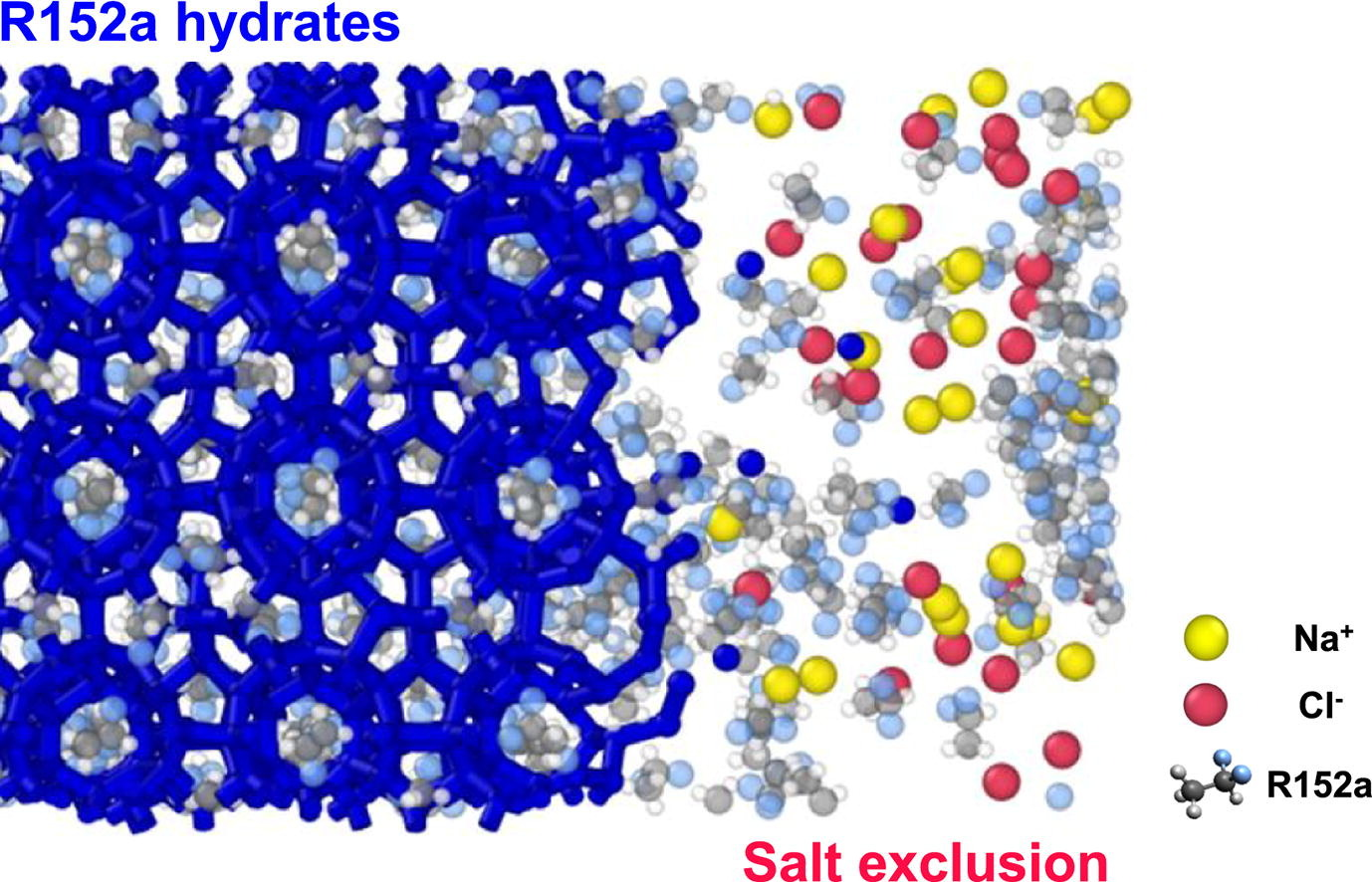
This study addressed the treatment of hypersaline brine, specifically solutions containing 5.0 wt% and 10.0 wt% NaCl, by exploring the use of 1,1-difluoroethane (C2H4F2, R152a) hydrate-based desalination (HBD). The thermodynamic stability of R152a hydrates under hypersaline conditions was experimentally measured and predicted utilizing the Hu-Lee-Sum correlation. Powder X-ray diffraction analysis confirmed that the crystal structure of R152a hydrates (structure I) remained unchanged under hypersaline brine conditions. Hydrate growth kinetics and desalination efficiency were investigated under various temperature driving forces (ΔT = 2 K, 3 K, and 5 K) to elucidate the impact of temperature variations on hydrate growth rates and salt removal capabilities. Elevated temperatures resulted in slower growth rates but yielded higher desalination efficiency. Furthermore, molecular dynamics simulations provided microscopic insights into the mechanisms underlying these observations. Molecular dynamics analyses of hydrate growth and ion diffusion demonstrated that at lower temperatures, ion movement slowed down, leading to more ions being trapped within the hydrates. Additionally, free energy calculations corroborated that Na+ ions were more easily removed than Cl- ions due to their lower free energy barriers. This study highlights the potential of R152a HBD as a sustainable solution for hypersaline brine treatment, emphasizing the necessity for further optimization and development to fully realize its practical applications.
본 연구는 고염수(hypersaline brine), 즉 NaCl 5.0 wt% 및 10.0 wt% 용액의 처리를 위해 1,1-디플루오로에탄(C₂H₄F₂, R152a) 하이드레이트 기반 담수화(HBD)의 활용 가능성을 검토하였습니다. 고염수 조건에서 R152a 하이드레이트의 열역학적 안정성을 실험적으로 측정하고 Hu–Lee–Sum 상관식을 이용하여 예측하였습니다. 분말 X선 회절(PXRD) 분석을 통해 R152a 하이드레이트의 결정 구조가 구조 I(sI)임을 확인하였으며, 고염수 조건에서도 구조 변화가 없음을 확인하였습니다.
하이드레이트 성장 동적과 담수화 효율은 온도 구동력(ΔT = 2 K, 3 K, 5 K) 조건하에서 조사하여, 온도 변화가 성장 속도와 염 제거 능력에 미치는 영향을 규명하였습니다. 온도가 높을수록 성장 속도는 느려졌으나 담수화 효율은 더 높게 나타났습니다. 더 나아가, 분자동역학(MD) 시뮬레이션을 통해 이러한 관찰의 기작을 분자 수준에서 해석하였습니다. 하이드레이트 성장과 이온 확산에 대한 MD 분석 결과, 낮은 온도에서는 이온 운동이 저하되어 더 많은 이온이 하이드레이트 내부에 포획되는 경향이 나타났습니다. 또한 자유에너지 계산을 통해 Na⁺ 이온이 Cl⁻ 이온보다 자유에너지 장벽이 낮아 더 쉽게 제거됨을 입증하였습니다.
종합하면, 본 연구는 R152a 기반 HBD가 고염수 처리의 지속가능한 해결책이 될 잠재력을 강조하며, 실용화를 위한 추가적인 최적화와 개발의 필요성을 시사합니다.