Abstract
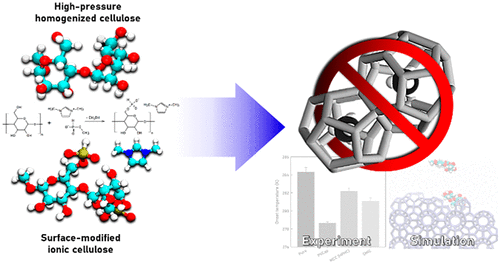
Cellulose is a cheap, ecofriendly, and abundant organic polymer. In this study, physically or chemically modified microcrystalline cellulose (MCC) was evaluated as a kinetic hydrate inhibitor (KHI) for CH4 hydrates using experimental and computational methods. To overcome the strong hydrophobicity of MCC, high-pressure homogenized cellulose (HPHC) was prepared by dispersing MCC homogeneously in water, and surface-modified ionic cellulose (SMIC) was obtained by attaching an ionic liquid (1,3-dimethylimidazolium methylphosphite, [DMIM][MP]) to the surface of MCC. The onset temperature and gas uptake of CH4hydrates were experimentally measured to examine the inhibition performance of HPHC and SMIC. Experimental results demonstrated that both HPHC and SMIC functioned as potential KHIs and SMIC had better inhibition capability than HPHC. Molecular dynamics simulations were performed to reveal the inhibition mechanisms of the KHIs during cage formation and hydrate growth. It was found that the different inhibition effects of the KHIs were caused by a combination of multiple inhibition mechanisms, including both their interactions with water and cage adsorption. Given the improved hydrophilicity and inhibition performance through physical or chemical modification of the naturally derived organic compound, cellulose holds great potential as a novel and green KHI.
셀룰로오스는 저렴하고 친환경적이며 풍부한 유기 고분자입니다. 본 연구에서는 실험 및 계산 방법을 통해 물리적 또는 화학적으로 개질한 미세결정 셀룰로오스(MCC)를 메탄(CH₄) 하이드레이트용 동적 하이드레이트 억제제(KHI)로 평가하였습니다. MCC의 강한 소수성을 극복하기 위해, 물에서 MCC를 균질하게 분산시켜 고압 균질화 셀룰로오스(HPHC)를 제조하였고, MCC 표면에 이온성 액체(1,3-디메틸이미다졸륨 메틸포스파이트, [DMIM][MP])를 도입하여 표면 개질 이온성 셀룰로오스(SMIC)를 얻었습니다. CH₄ 하이드레이트의 생성 개시 온도와 가스 흡수량을 실험적으로 측정하여 HPHC와 SMIC의 억제 성능을 평가하였습니다. 실험 결과, HPHC와 SMIC 모두 잠재적 KHI로 기능하였으며, SMIC가 HPHC보다 더 우수한 억제 능력을 보였습니다. 케이지 형성 및 하이드레이트 성장 과정에서의 KHI 억제 메커니즘을 규명하기 위해 분자동역학(MD) 시뮬레이션을 수행하였고, KHI 간 억제 효과의 차이는 물과의 상호작용 및 케이지 흡착을 포함한 복합적인 억제 메커니즘의 결합에 기인함을 확인하였습니다. 자연 유래 유기 화합물인 셀룰로오스를 물리·화학적으로 개질함으로써 친수성과 억제 성능이 향상된 점을 고려할 때, 셀룰로오스는 신규이자 친환경적인 KHI로서 큰 잠재력을 지닙니다.