Abstract
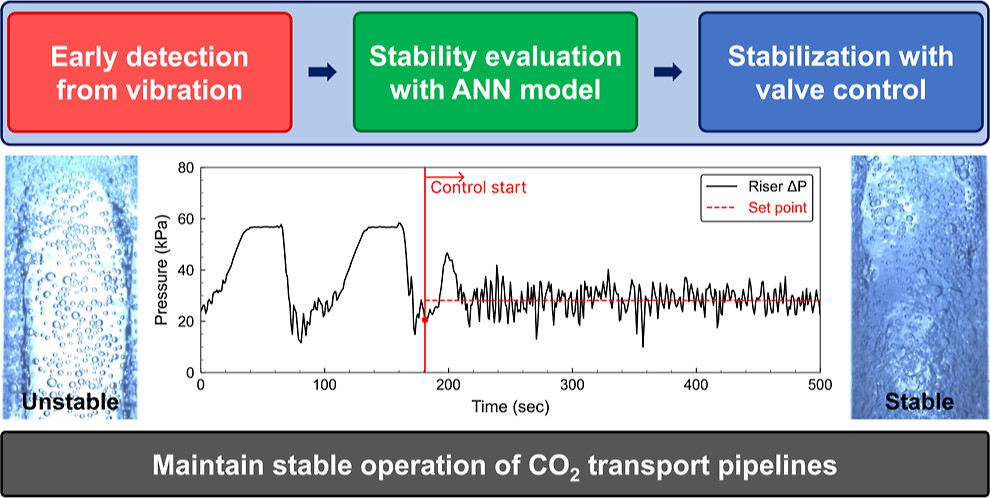
This study addresses the challenge of two-phase flow-induced vibrations (FIVs) in CO2 transport pipelines, which are crucial for safe operation of the pipelines and processing facilities for carbon capture and storage (CCS) projects. The formation of two-phase flow due to phase changes may induce vibrations of pipelines, especially in riser sections of offshore platforms. Conventional design strategies to mitigate FIVs may not be applicable to the CO2 transport pipelines in the case of reuse of the existing infrastructures. This study investigates the performance of a flow control system coupled with a machine learning algorithm for early detection and prevention of FIVs. Experiments were conducted using a flow loop using air and water to simulate two-phase flow and to obtain both vibration and pressure fluctuation data, and then those data were used to develop and train an artificial neural network (ANN) model. This ANN model effectively identifies two-phase unstable flows (USFs) and initiates an internal model control logic to adjust the valve opening of the flow control system. Upon adjusting the valve opening, stable two-phase flow was obtained. The obtained results demonstrated that early detection and timely control should reduce the maximum pressure and the duration of USFs. The control system was also applied to the simulation model for the offshore CO2 transport pipeline for the CCS project in the East Sea of Korea and proved its effectiveness to minimize the impact of two-phase USF. These results suggest that implementing this ML-based control system enhances the safety and reliability of CO2 transport pipelines, making CCS projects more economically viable by utilizing existing infrastructure.
본 연구는 탄소 포집·저장(CCS) 프로젝트의 파이프라인 및 처리 설비의 안전 운전에 핵심적인 CO₂ 수송 파이프라인에서의 2상 유동 유발 진동(FIV) 문제를 다루었습니다. 상변화로 인해 2상 유동이 형성되면, 특히 해양 플랜트의 라이저 구간에서 파이프라인 진동이 유발될 수 있습니다. 기존 인프라를 재사용하는 경우에는 전통적인 FIV 저감 설계 전략을 CO₂ 수송 파이프라인에 그대로 적용하기 어려울 수 있습니다. 이에 본 연구는 FIV의 조기 탐지와 예방을 위해 기계학습(ML) 알고리즘과 결합된 유동 제어 시스템의 성능을 조사하였습니다.
공기와 물을 이용한 유동 루프(flow loop) 실험을 통해 2상 유동을 모사하고 진동 및 압력 변동 데이터를 획득하였으며, 이를 바탕으로 인공신경망(ANN) 모델을 개발·학습시켰습니다. 해당 ANN 모델은 2상 불안정 유동(USF)을 효과적으로 식별하고, 유동 제어 시스템의 밸브 개도를 조정하기 위한 내부 모델 제어(IMC) 논리를 구동합니다. 밸브 개도 조정 후에는 안정적인 2상 유동이 확보되었습니다. 얻어진 결과에 따르면 조기 탐지와 적시 제어는 USF의 최대 압력과 지속 시간을 감소시킬 수 있음을 보여주었습니다.
아울러, 본 제어 시스템을 대한민국 동해 CCS 프로젝트를 위한 해상 CO₂ 수송 파이프라인 시뮬레이션 모델에 적용한 결과, 2상 USF 영향 최소화에 유효함을 확인하였습니다. 이러한 결과는 ML 기반 제어 시스템의 도입이 CO₂ 수송 파이프라인의 안전성과 신뢰성을 향상시키며, 기존 인프라의 활용을 통해 CCS 프로젝트의 경제성 제고에도 기여할 수 있음을 시사합니다.