Abstract
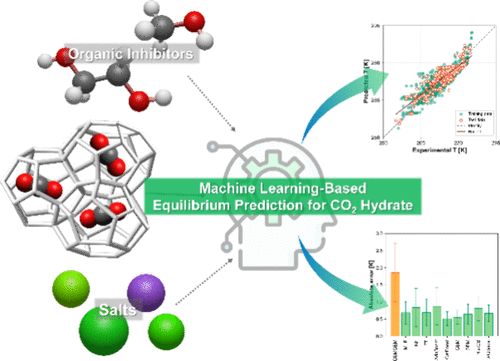
In this study, 13 machine learning (ML) models were employed to predict the phase equilibrium temperatures of the CO2 hydrate in systems with salts and organic inhibitors: Multiple Linear Regression (MLR), Support Vector Regression (SVR), k-Nearest Neighbors (KNN), Multi-Layer Perceptron (MLP), Decision Tree (DT), Random Forest (RF), Extra Trees (ET), Adaptive Boosting (AdaBoost), Categorical Boosting (CatBoost), Gradient Boosting Machine (GBM), Light Gradient Boosting Machine (LGBM), Histogram-Based Gradient Boosting (HistGB), and eXtreme Gradient Boosting (XGBoost). A dataset consisting of 1801 experimentally measured equilibrium data points was gathered, which included both pure water systems and systems with thermodynamic inhibitors. After data preprocessing, 1402 data points were selected for ML training and validation. Boosting algorithms generally yielded high predictive accuracy, with the MLP demonstrating notably superior accuracy. The predicted equilibrium temperatures for complex systems containing both salts and organic inhibitors were also compared with those calculated by the widely used CSMGem software. With the exception of SVR, KNN, and DT, all models outperformed CSMGem, in terms of statistical assessment. Specifically, the CatBoost model accurately predicted equilibrium temperatures for most test sets of combinations of salts and organic inhibitors. This study underscores the viability of ML models for predicting the phase equilibria of the CO2 hydrate in the presence of single and mixed thermodynamic inhibitors.
본 연구는 염 및 유기 억제제가 존재하는 계에서 CO₂ 하이드레이트의 상평형 온도를 예측하기 위해 13종의 기계학습(ML) 모델을 적용하였습니다: 다중 선형 회귀(Multiple Linear Regression, MLR), 서포트 벡터 회귀(Support Vector Regression, SVR), k-최근접 이웃(k-Nearest Neighbors, KNN), 다층 퍼셉트론(Multi-Layer Perceptron, MLP), 의사결정나무(Decision Tree, DT), 랜덤 포레스트(Random Forest, RF), 엑스트라 트리즈(Extra Trees, ET), 에이다부스트(Adaptive Boosting, AdaBoost), 캐트부스트(Categorical Boosting, CatBoost), 그래디언트 부스팅 머신(Gradient Boosting Machine, GBM), 라이트GBM(Light Gradient Boosting Machine, LGBM), 히스토그램 기반 그래디언트 부스팅(Histogram-Based Gradient Boosting, HistGB), 익스트림 그래디언트 부스팅(eXtreme Gradient Boosting, XGBoost).
총 1801개의 실험 상평형 데이터 포인트로 구성된 데이터셋을 수집하였으며, 여기에는 순수 물 시스템과 열역학적 억제제가 존재하는 시스템이 모두 포함되었습니다. 데이터 전처리 후 1402개 데이터를 학습 및 검증에 사용하였습니다. 전반적으로 부스팅 계열 알고리즘이 높은 예측 정확도를 보였고, 특히 MLP가 두드러진 정확도를 나타냈습니다.
또한 염과 유기 억제제가 동시에 존재하는 복합 시스템에 대해 예측된 상평형 온도를 널리 사용되는 CSMGem 소프트웨어의 계산값과 비교하였습니다. SVR, KNN, DT를 제외한 모든 모델이 통계적 평가 기준에서 CSMGem을 상회하였습니다. 특히 CatBoost 모델은 염과 유기 억제제 조합의 대부분 테스트 세트에서 상평형 온도를 정확하게 예측하였습니다.
요약하면, 본 연구는 단일 및 혼합 열역학적 억제제 존재 하에서 CO₂ 하이드레이트 상평형을 예측하는 데 ML 모델의 적용 가능성과 유효성을 강조합니다.