Abstract
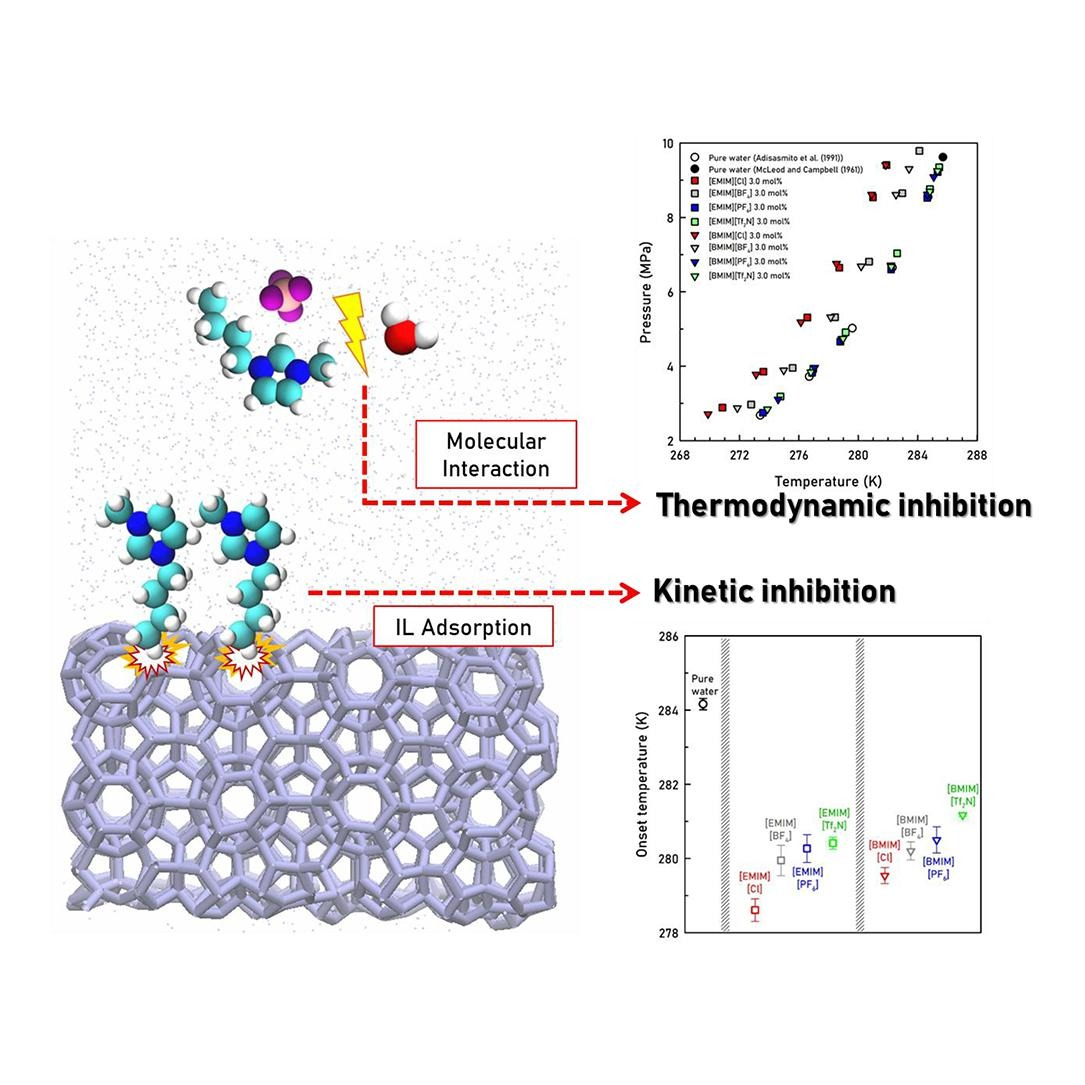
Ionic liquids (ILs) have gained significant attention as dual-functional hydrate inhibitors, serving as thermodynamic and kinetic hydrate inhibitors. This study aimed to investigate a crucial factor determining the inhibition performance of ILs for CH4 hydrate, focusing primarily on their hydrophilicity or hydrophobicity, through a combination of experimental techniques and molecular dynamics simulations. The experimental results demonstrated that the thermodynamic and kinetic inhibitions of ILs for CH4 hydrate were influenced by their hydrophilicity or hydrophobicity, with more hydrophilic ILs exhibiting superior hydrate inhibition. Notably, hydrophobic ILs acted as kinetic hydrate inhibitors but lacked thermodynamic hydrate inhibition properties. Simulation results revealed that the thermodynamic inhibition of ILs originated from their interaction with water, which was stronger for more hydrophilic ILs, while IL adsorption on the growing hydrate surface served as a major mechanism for their kinetic hydrate inhibition. Free energy calculations confirmed the thermodynamic feasibility of IL adsorption on CH4 hydrate. Moreover, more hydrophilic ILs were found to be more likely to be adsorbed onto the hydrate surface due to their stronger binding affinity. Therefore, these findings contribute to a better understanding of the inhibition mechanism of ILs as dual-functional hydrate inhibitors and have implications for the development of new hydrate inhibitors.
이온성 액체(IL)는 열역학적 및 동적 하이드레이트 억제제(각각 THI, KHI)로 작용하는 이중 기능성 억제제로 주목받아 왔습니다. 본 연구는 IL의 메탄(CH₄) 하이드레이트 억제 성능을 결정하는 핵심 인자로서 친수성/소수성에 초점을 맞추어, 실험 기법과 분자동역학(MD) 시뮬레이션을 병행하여 규명하고자 하였습니다. 실험 결과, IL의 CH₄ 하이드레이트에 대한 열역학적 억제와 동적 억제는 그 친수성/소수성에 의해 좌우되었으며, 친수성이 큰 IL일수록 더 우수한 억제 성능을 보였습니다. 특히 소수성 IL은 동적 하이드레이트 억제제로는 작용하였으나 열역학적 억제 특성은 나타나지 않았습니다.
본 연구에서 수행된 시뮬레이션에 따르면, IL의 열역학적 억제는 물과의 상호작용에서 기원하며, 친수성이 클수록 그 상호작용이 강해집니다. 반면, 성장 중인 하이드레이트 표면에 대한 IL의 흡착이 동적 억제의 주된 메커니즘으로 작용함을 확인하였습니다. 자유에너지 계산은 IL의 CH₄ 하이드레이트 표면 흡착이 열역학적으로 가능함을 뒷받침하였고, 더 친수성인 IL일수록 결합 친화도가 커 표면에 흡착될 가능성이 높음을 보였습니다. 이러한 결과는 이온성 액체의 이중 기능성 하이드레이트 억제 메커니즘에 대한 이해를 심화하고, 신규 하이드레이트 억제제 개발에 시사점을 제공합니다.