Abstract
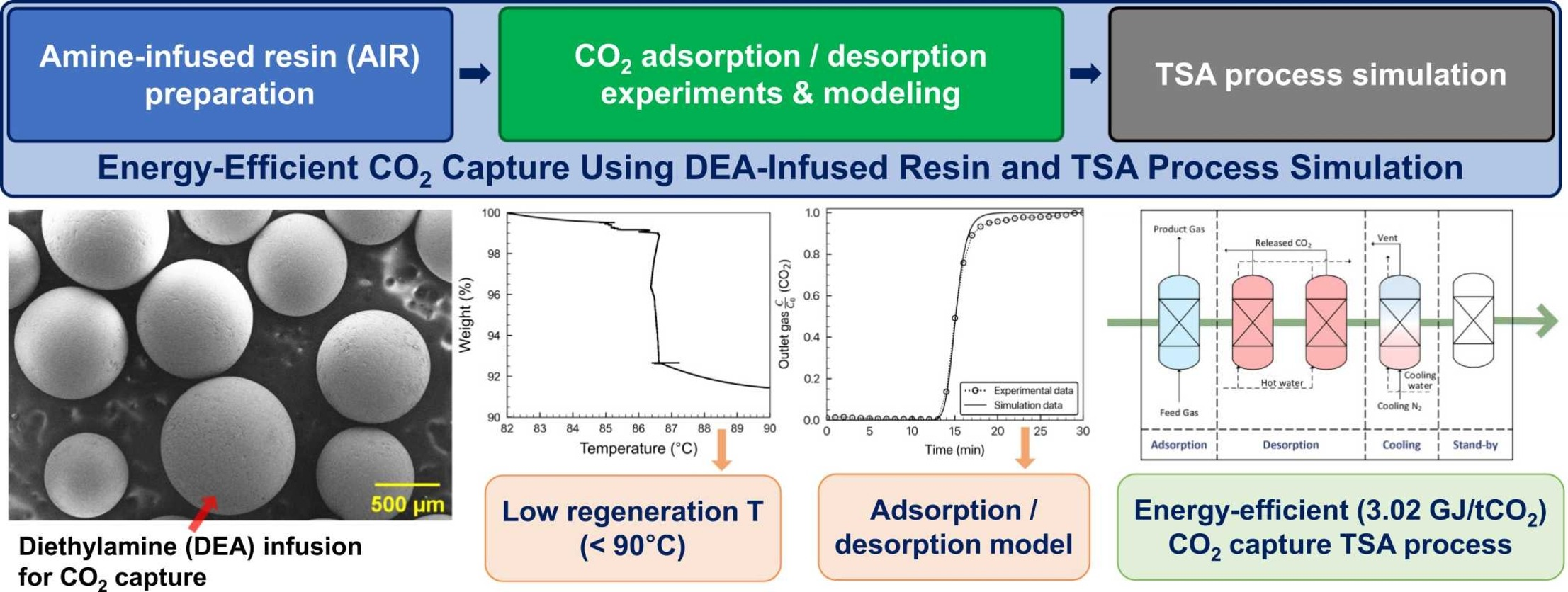
Selective capture of CO2 using solid CO2 sorbents provides an effective solution for a simplified CO2 capture process, however it demands high CO2 capture performance with low regeneration energy. A solid adsorbent incorporating diethanolamine (DEA) within a cross-linked polystyrene based porous ion-exchange resin was synthesized. DEA was incorporated into the channels of the resin by infusion, denoted as an amine-infused resin (AIR). Performance of the AIR in CO2 adsorption was evaluated, then the desorption properties were measured along with the surface morphology and particle size distribution. The commercial process simulator Aspen Adsorption was employed to model the single-bed experimental system. Simulation results showed good agreement with experimental data, particularly in terms of breakthrough behavior and CO2 holdup during adsorption–desorption cycles. The validated model was used to design a CO2 capture system adopting temperature swing adsorption (TSA) for CO2 removal from gas stream. The five-column TSA unit operating at 2 bar produced a CO2 stream with three-step cycle of adsorption, desorption by hot water, and cooling. The overall energy consumption of 3.02 GJ/tCO2 was estimated from the total amount of heat during desorption of 53.9 kJ/mol CO2. The reduced regeneration temperature and energy requirements for the AIR results in improved productivity. The findings of this study highlight the potential of AIR as a promising alternative for CO2 capture process with several advantages, including comparable CO2 capture performance, efficient regeneration, and scalability.
선택적 CO₂ 고체 흡착제는 CO₂ 포집 공정을 단순화할 수 있는 효과적 방법이지만, 높은 포집 성능과 낮은 재생 에너지가 동시에 요구된다. 본 연구에서는 가교된 polystyrene계 다공성 이온교환수지 내부에 diethanolamine(DEA)을 주입한 고체 흡착제를 합성하였으며, 이를 amine-infused resin(AIR)이라 하였다. AIR의 CO₂ 흡착 성능을 평가하고, 탈착 특성, 표면 형상, 입도 분포를 분석하였다. 또한 Aspen Adsorption을 이용해 단일층 실험계를 모델링하였다. 시뮬레이션은 특히 breakthrough 거동과 흡·탈착 반복 시 CO₂ holdup 측면에서 실험과 잘 일치하였다. 검증된 모델을 바탕으로 gas stream 중 CO₂ 제거를 위한 temperature swing adsorption(TSA) 공정을 설계하였다. 2 bar에서 운전되는 5탑 TSA 공정은 흡착, 온수 탈착, 냉각의 3단계 사이클로 고농도 CO₂ 유출가스를 생산하였다. 탈착 시 총 열량은 53.9 kJ/mol CO₂였고, 전체 에너지 소비는 3.02 GJ/tCO₂로 추산되었다. AIR는 낮은 재생 온도와 에너지 요구량 덕분에 생산성이 향상되었으며, 유사한 CO₂ 포집 성능, 효율적 재생, 확장성을 갖는 유망한 대안으로 평가된다.
JIF rank & percentile