Abstract
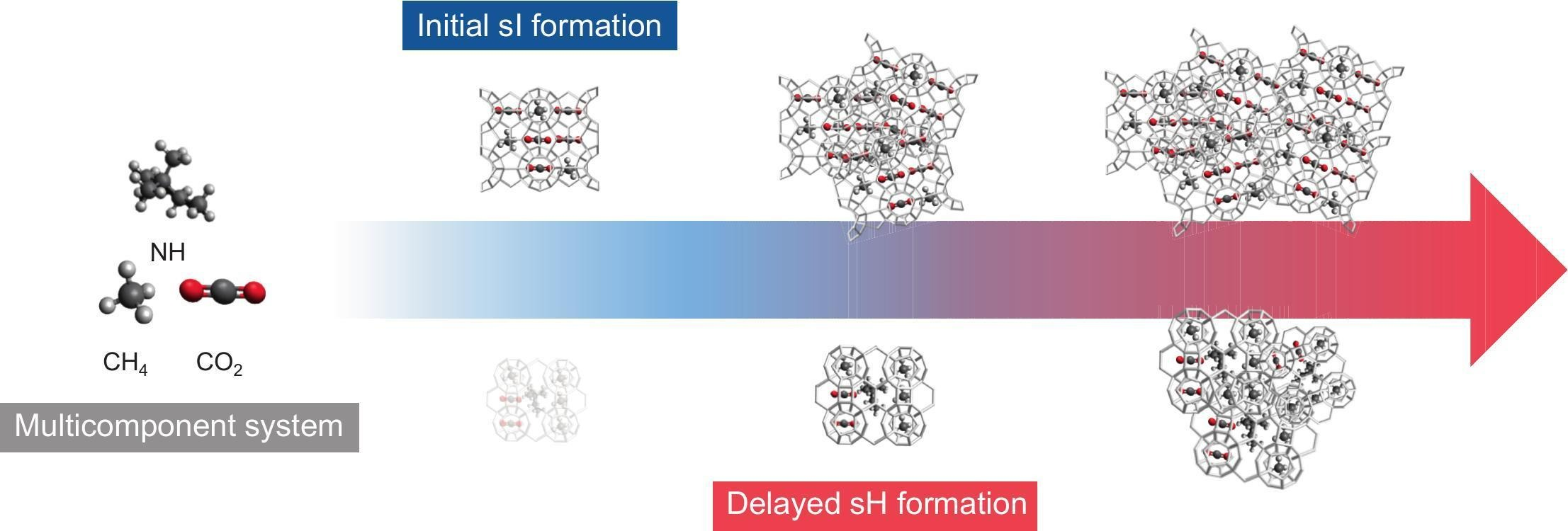
Secondary hydrate formation from CH4 + CO2 mixtures is an inevitable phenomenon during CO2 replacement in structure H (sH) hydrates, yet its mechanistic pathways remain poorly understood. This study systematically examined competitive crystallization and cage-specific guest partitioning in the CH4 + CO2 + NH (neohexane) system using integrated thermodynamic, spectroscopic, and diffraction-based analyses. Phase equilibrium measurements revealed that at lower pressures, the system favored sH hydrate formation, but at elevated pressures the equilibrium boundary gradually approached and ultimately converged with that of structure I (sI) hydrate. Kinetic monitoring showed that in the NH-containing system, vapor-phase CO2 composition initially declined but later exhibited a distinct compositional jump, unlike the monotonic trend observed in pure water. In-situ Raman spectroscopy confirmed preferential nucleation of sI hydrate followed by delayed crystallization of sH hydrate. Complementary 13C NMR and powder X-ray diffraction analyses demonstrated that while CO2 remained largely confined to the large cages of sI hydrate, CH4 was increasingly captured in the small cages of sH hydrate during the later growth stage, accounting for the observed compositional step change. These results provide the first integrated cage-level description of guest distributions across coexisting sI and sH hydrates in CH4 + CO2 + NH systems. By establishing fundamental parameters for CO2 storage capacity and CH4 recovery efficiency, the study clarifies the role of secondary hydrate formation as a governing process in guest replacement and offers implications for hydrate-based strategies in gas separation, storage, and energy recovery.
CH₄ + CO₂ 혼합계에서 structure H(sH) hydrate의 CO₂ 치환 과정 중 발생하는 2차 hydrate 형성은 피할 수 없는 현상이지만, 그 기작은 아직 충분히 규명되지 않았다. 본 연구에서는 CH₄ + CO₂ + NH(neohexane) 계를 대상으로, 열역학·분광학·회절 분석을 통합하여 경쟁적 결정화와 cage별 guest 분배 거동을 체계적으로 규명하였다. 상평형 측정 결과, 낮은 압력에서는 sH hydrate 형성이 우세하였으나, 압력이 증가할수록 평형 경계는 점차 structure I(sI) hydrate의 경계에 가까워졌고 최종적으로 수렴하였다. 속도론 분석에서는 NH가 존재하는 계에서 기상 CO₂ 조성이 초기에 감소한 뒤 다시 뚜렷하게 증가하는 조성 점프가 관찰되었으며, 이는 순수 물 계의 단조 감소 경향과 구별되었다. In-situ Raman 분석 결과, sI hydrate가 먼저 핵생성되고 이후 sH hydrate가 지연 형성되는 것이 확인되었다. 또한 13C NMR과 분말 X선 회절 분석을 통해 CO₂는 주로 sI hydrate의 large cage에 존재하는 반면, 성장 후반부에는 CH₄가 sH hydrate의 small cage에 점차 더 많이 포집됨이 확인되었고, 이것이 관찰된 조성 점프의 원인으로 해석되었다. 본 연구는 CH₄ + CO₂ + NH 계에서 공존하는 sI 및 sH hydrate 내 guest 분포를 cage 수준에서 통합적으로 설명한 첫 결과이다. 나아가 CO₂ 저장용량과 CH₄ 회수효율 평가에 필요한 기초 인자를 제시함으로써, 2차 hydrate 형성이 guest 치환 과정의 지배적 요인임을 밝히고, hydrate 기반 가스 분리·저장·에너지 회수 전략에 중요한 시사점을 제공하였다.